AI Planning

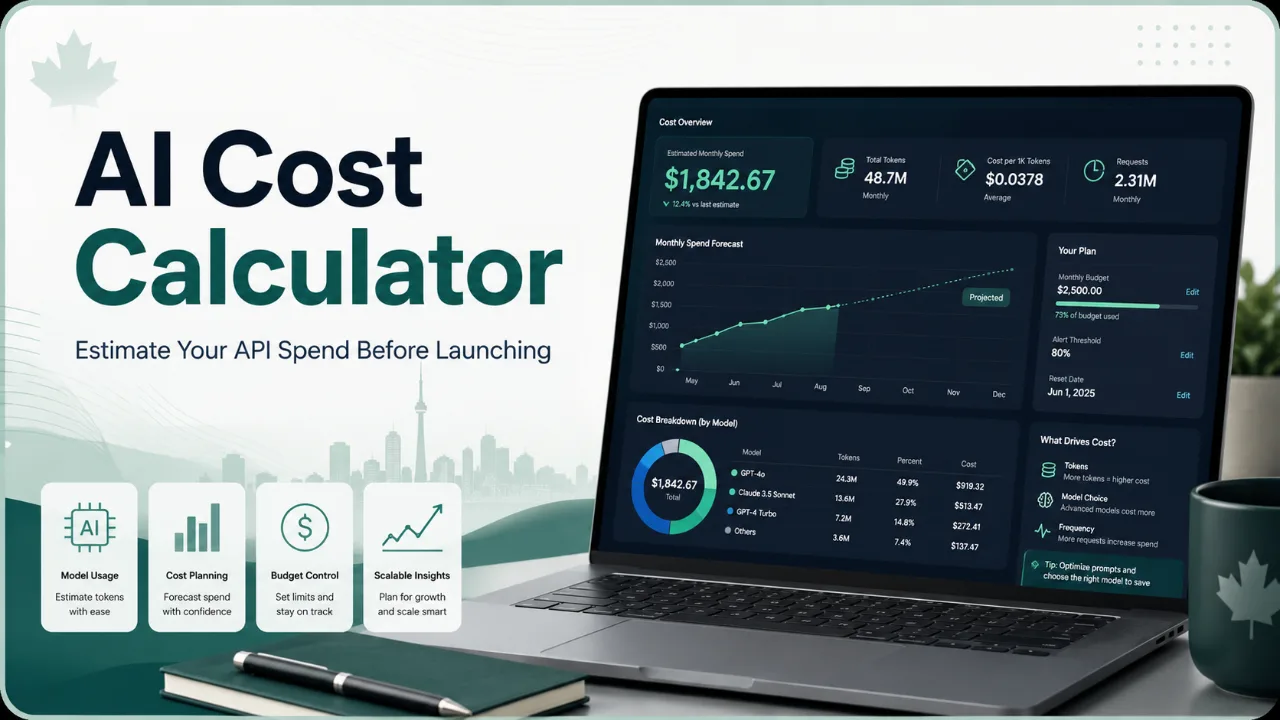
AI Cost Calculator: Estimate Your AI API Spend Before Launching

Last updated May 31, 20269 min read
By Gourav KumarReviewed against current Canadian source materialLast verified for 2026Fact-checked against official Canadian sourcesEditorial standardsReport an issue
GK

Gourav Kumar, Founder of Easy Finance Tools

Independent Canadian finance tools creator. Educational content only; not a licensed financial advisor, accountant, mortgage broker, or tax professional.

About the authorLast reviewed: Last updated May 31, 2026
Article visualAI Planning
Canadian finance education editorial illustration

AI Cost Calculator: Estimate Your AI API Spend Before Launching

Updated for 2026 Canadian rules
Quick AnswerEstimate the cost before the product exists

AI API spend is usually driven by request volume, input tokens, output tokens, extra agent loops, retrieved context, image calls, and provider pricing. A useful estimate should also account for CAD/USD conversion, non-API operating costs, pricing tiers, and the assumptions most likely to break.

  • API cost is not only monthly users. Tokens, retries, RAG context, and agent loops can change the bill quickly.
  • Subscription AI tools may be simpler for internal use, while API usage is usually more flexible but less predictable.
  • Open-source models can reduce direct API dependency but may add hosting, engineering, monitoring, and security costs.
  • Canadian teams should separately consider USD pricing, FX movement, GST/HST, bookkeeping, and professional advice where needed.

How to use this guide

Read for the decision, then verify the rule

What changes the answer?

Look for the income, timeline, account-room, province, tax, or risk assumption that would make the conclusion weaker.

What source applies?

Use the official links below for rules, limits, tax treatment, benefit dates, or mortgage guidance before acting.

What is not covered?

Personal tax history, contribution-room records, employer plans, debt terms, and household constraints may change the practical decision.

Founder review

Written and maintained by Easy Finance Tools

This page is written and maintained by Easy Finance Tools, checked against official Canadian sources where applicable, and not reviewed by a licensed financial advisor unless a reviewer is explicitly named.

Source verification

Checked against official Canadian sources where applicable

Last updated: May 31, 2026

Last verified for 2026: official rule pages and source links checked where they apply.

What was checked

  • - Primary source links where applicable
  • - Educational disclaimer and decision caveats
  • - Related calculator and guide links
  • - No professional review claim unless explicitly provided

Known limitations

  • - This guide cannot see personal account room, tax filing history, employment benefits, debts, or household constraints.
  • - Official rules and eligibility should be verified before acting.
This page is for education and planning support only. It is not financial, tax, legal, mortgage, or investment advice. Report an error or outdated source.

AI features can look inexpensive during a prototype and become uncomfortable once real users arrive. A chat assistant, document summarizer, support agent, or internal workflow may make several model calls for one visible user action. If the product also retrieves documents, processes images, retries failed calls, or keeps long chat history, the simple estimate can drift quickly.

The goal is not to predict the invoice perfectly. The goal is to understand which assumptions matter before launch. This article explains the tradeoff between API, subscription, and open-source AI, the math behind API estimates, what can break the estimate, and how Canadian businesses should think about CAD planning.

The tradeoff: API vs subscription vs open-source AI

There is no single cheapest AI path. API-based AI is flexible because you can build it directly into your product, automate workflows, control prompts, and meter usage. The tradeoff is that cost depends on real behaviour: request volume, token length, model choice, retries, and product design.

Subscription AI tools are usually easier for internal use. A business may pay a predictable monthly fee per employee and avoid building infrastructure. But subscription tools may not fit a customer-facing product, may have usage policies or limits, and may not provide the exact workflow or data controls a team needs.

Open-source or self-hosted models can reduce dependency on a per-token API price, but they are not automatically free. Hosting, GPUs, engineering time, observability, evaluation, security review, and maintenance can become the real cost. For some teams that control is worth it; for others it is complexity too early.

PathUsually stronger whenWatch for
APIYou need product integration, metering, and model flexibilityToken growth, retries, agent loops, provider price changes
SubscriptionThe use case is mostly internal and seat-basedUsage limits, workflow fit, data policy, per-seat scaling
Open-sourceYou have technical capacity and need controlHosting, engineering time, security, monitoring, support

The math: how AI API costs are calculated

Most AI API estimates start with a simple formula: model calls multiplied by input tokens and output tokens, then multiplied by the provider's price per million tokens. That sounds clean, but the hard part is choosing realistic inputs.

A customer support bot might receive one message from the user, then add a system prompt, conversation history, retrieved policy documents, tool outputs, and a long final response. An agent workflow might make three to eight model calls behind the scenes. A document feature might process far more tokens than the user sees on screen.

A better estimate separates base monthly requests, agent loop multiplier, retrieved-document tokens, input tokens, output tokens, image or vision calls, cache savings, and non-AI business costs. That structure makes it easier to see which assumption deserves a stress test.

  • Monthly requests estimate how often the feature is used.
  • Input tokens include prompts, chat history, retrieved documents, and tool context.
  • Output tokens include model responses, structured JSON, summaries, or generated text.
  • Agent loop multiplier estimates hidden repeated calls in multi-step workflows.
  • Image or vision costs may be priced separately from text tokens depending on provider rules.

What could break the estimate

The fragile part of an AI estimate is usually not the spreadsheet. It is the single assumption nobody challenged. Monthly usage might be higher than expected. Average output length might double. A product decision might add RAG context to every request. A support agent might retry or call tools more often than the prototype suggested.

Pricing can also change. Provider token prices, subscription tiers, caching discounts, rate limits, model availability, and usage policies can move over time. Treat official provider pricing pages and real invoices as the final source before making a commitment.

The estimate can also miss costs outside the API bill: implementation time, employee training, prompt engineering, monitoring, data privacy compliance, security review, human review, downtime risk, and support. Direct model cost is important, but it is not the whole operating cost.

Canadian business planning notes

Many AI providers publish prices in USD. A Canadian budget should convert those assumptions into CAD and leave room for exchange-rate movement. If revenue is in Canadian dollars but AI cost is in USD, the margin can move even when user behaviour does not.

Canadian teams should also think separately about GST/HST, income tax treatment, bookkeeping, and whether the AI system touches sensitive customer or employee data. This article and the calculator are planning tools, not accounting or legal advice.

For a small Canadian business, the practical question is often: what has to be true for this feature to stay affordable? That may include usage limits, cheaper fallback models, shorter context windows, caching, pricing tiers, or a slower rollout.

Try the AI Cost Calculator

The AI Cost Calculator lets you model requests, tokens, agent loops, retrieved-document tokens, image or vision cost, CAD/USD conversion, infrastructure, payment fees, support costs, and break-even pricing in one place.

Use it before launch to compare whether the workflow still makes sense under conservative assumptions. Then check the broader tools page if the estimate changes your budget, pricing, savings, or account-planning decisions.

  • Start with /tools/ai-cost-calculator to estimate direct and supporting costs.
  • Use /tools to compare other financial planning calculators after the AI estimate changes your budget.
  • Use /tools/account-decision-tool if the project affects personal cash flow, TFSA/RRSP/FHSA contributions, or emergency-fund planning.

Next path after estimating AI costs

Once the estimate is built, avoid treating the first answer as the budget. Run a low, middle, and high usage scenario. Change one input at a time: monthly requests, response length, agent loop multiplier, RAG tokens, paid conversion rate, and subscription price.

If the estimate is tight, the next move is usually not optimism. It is a design decision: reduce token length, choose a cheaper model for routine tasks, cache stable context, set usage caps, simplify the workflow, or delay expensive automation until there is enough revenue to support it.

If the AI project affects your own savings or business cash flow, connect the estimate back to broader financial planning. Registered accounts like TFSA, RRSP, and FHSA are separate personal decisions, but major business spending can change how much room you have for them.

What people misunderstand

What actually matters for Canadians

Token cost is not the only cost

Direct API spend matters, but implementation, monitoring, security, support, and compliance can be material.

A cheaper model is not always cheaper overall

If a weaker model creates more retries, support work, or failed tasks, the apparent saving may shrink.

Open-source is not automatically free

Self-hosting can move cost from provider invoices into engineering, infrastructure, and operations.

CAD planning needs FX context

A USD-denominated API bill can affect Canadian-dollar margin when exchange rates move.

Before you decide

When this strategy may not fit

  • -You need a binding quote from an AI vendor or cloud provider.
  • -You need accounting, tax, legal, security, or procurement advice.
  • -You do not yet know the workflow well enough to estimate requests, tokens, or model calls.
  • -Your organization requires formal technical architecture review before choosing a provider.

Common edge cases

Where the simple answer can be wrong

Agent workflows

One user action can trigger several model calls, tool calls, retrieval steps, and retries.

Large-document RAG

Retrieved context can quietly become the main input-token driver.

Image and vision usage

Image analysis, generation, or multimodal workflows may use different pricing rules.

Provider terms

Rate limits, acceptable-use rules, caching policies, and enterprise terms can matter as much as the headline price.

Example scenario

Example: customer support agent before launch

A founder expects 1,000 monthly users, two support questions per user per month, 900 input tokens, 450 output tokens, and one model call per request. That prototype estimate may look manageable.

After adding retrieved help-doc context and a multi-step agent flow, each visible question may now trigger three model calls and several thousand extra input tokens. The user count did not change, but the cost structure did. That is why the estimate should be stress-tested before pricing the product.

Common mistakes

Mistakes to avoid

Estimating only the visible user prompt

System prompts, chat history, retrieved documents, and tool output can make the real input much larger.

Ignoring the agent multiplier

A prototype that makes one call can become a production flow that makes several calls.

Using provider pricing once and never checking again

Token prices, tiers, policies, and model names can change, so source checks should be part of launch planning.

Forgetting non-API operating costs

AI cost can be small compared with support, monitoring, privacy, security, and implementation time.

Related content

Use these next

Each guide points to one practical calculator and two related guides so the next step stays educational instead of promotional.

How this article was prepared

Last updated: May 31, 2026

This article explains AI cost estimation using request volume, token usage, agent loops, retrieved context, image add-ons, provider pricing, CAD/USD conversion, and simplified business operating-cost assumptions.

Assumptions

  • Provider prices and model names can change after publication.
  • Examples are simplified and do not model every billing feature, retry pattern, cache rule, tax treatment, or procurement requirement.
  • Canadian planning notes are educational and should be reviewed against professional advice where needed.

Sources and review

Self-reviewed by: Gourav Kumar

Checked against official Canadian source material where applicable; not reviewed by a licensed financial advisor, accountant, mortgage broker, or tax professional unless explicitly stated.

Verify current provider pricing and terms directly before making financial commitments.

Official sources

Official Canadian sources to verify

These primary references help readers verify the Canadian rules, limits, and tax treatment discussed in this guide.

Review note

Educational content, source-led review

This page is written for Canadian readers and reviewed against official or primary sources where the topic depends on rules, tax treatment, or account mechanics. The goal is to explain the decision, not to recommend a product or predict returns.

Last reviewed: May 31, 2026How we review content

Author and review

GK

Gourav Kumar

Founder of Easy Finance Tools

Independent Canadian personal finance tools creator focused on calculators, investing education, and beginner-friendly financial planning. Not a licensed financial advisor, accountant, mortgage broker, or tax professional.

How this content is handled

Content is educational, reviewed against official Canadian sources where applicable, and updated when account rules, calculator assumptions, or source material changes. It is not professional financial advice.

Editorial standardsCalculator methodologyUpdated: May 31, 2026AI Planning

Educational disclaimer

This article is for educational planning only and is not financial, tax, legal, accounting, or technical advice.

Reader feedback

Was this useful?

This saves only in your browser for now; no account or tracking profile is created.

FAQ

Frequently asked questions

Does the AI Cost Calculator predict my exact invoice?

No. It creates an educational planning estimate from your assumptions. Actual invoices can differ because of pricing changes, retries, caching, tokenization, model routing, and provider-specific billing rules.

Should I use API, subscription, or open-source AI?

This article does not recommend a vendor or deployment model. API, subscription, and open-source approaches each have tradeoffs around flexibility, predictability, control, technical complexity, and total operating cost.

Why include Canadian business planning notes?

Many AI prices are published in USD, while many Canadian businesses earn and budget in CAD. FX movement, GST/HST, bookkeeping, and professional review can matter before committing to a launch budget.

Are calculator inputs stored?

No. The AI Cost Calculator runs client-side in your browser. EasyFinanceTools does not store calculator inputs in a database.

Back to Blog