Covered call ETFs are popular with Canadian investors because the distributions can look high and predictable. Inside a TFSA, those distributions may feel even more attractive because qualifying withdrawals are tax-free.
The danger is treating a high yield as a complete strategy. A covered call ETF is not just a dividend ETF with a bigger payout. It uses an options strategy that can change upside, income stability, volatility, and long-term compounding. This guide explains how to evaluate the fit inside a TFSA.
The tradeoff: tax-free income vs capped upside
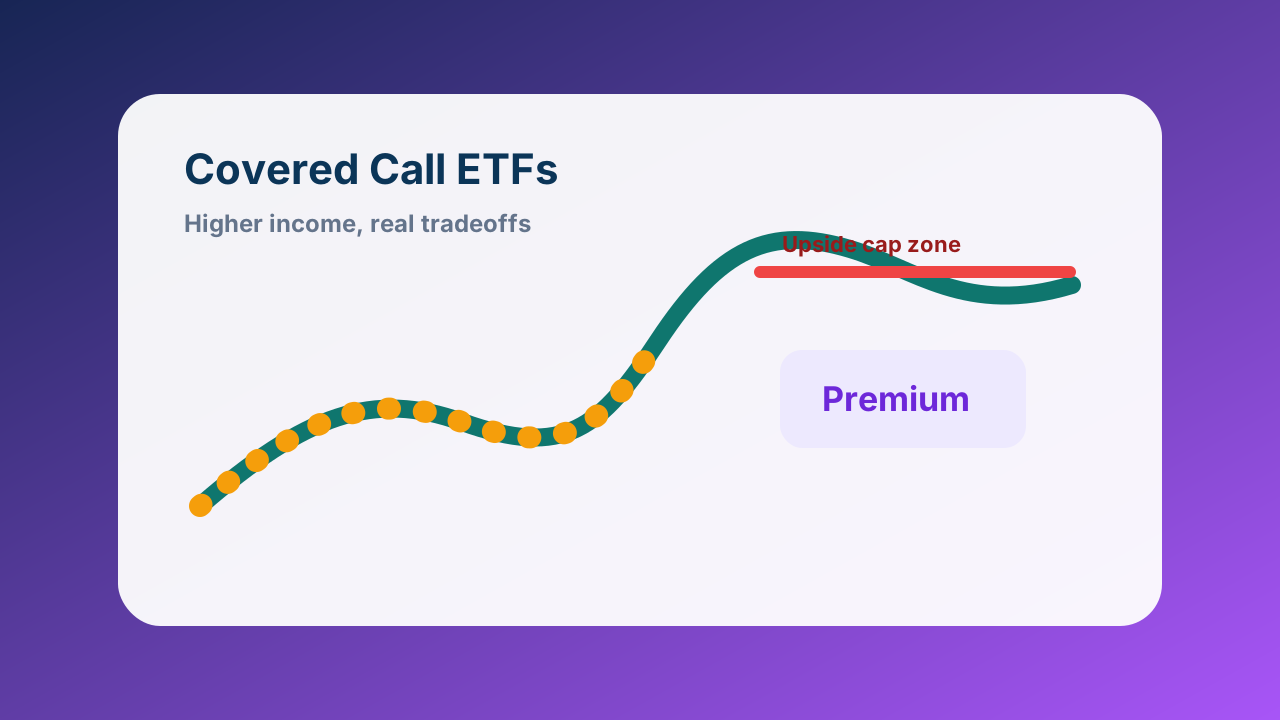
A covered call ETF typically owns a portfolio of securities and sells call options on some or all of that exposure. The option premiums can support higher distributions. The tradeoff is that part of the portfolio's upside may be capped when markets rise strongly.
In a TFSA, the income can be tax-free to withdraw, which is attractive for investors who want cash flow. But if the account's main job is long-term growth, giving up upside may be a real cost. The TFSA shelters growth too, not only income.
| TFSA goal | Covered call ETF may fit when | It may be weaker when |
|---|---|---|
| Current income | You want distributions and accept strategy tradeoffs | The payout is needed but capital volatility would be stressful |
| Long-term growth | It is a small satellite position | It replaces a broad growth core entirely |
| Risk control | Lower volatility matters more than maximum upside | You expect equity-like upside with bond-like stability |
| Simplicity | You understand the option strategy | You are buying only because the yield is high |
The calculation: yield is not the same as wealth growth
The first calculation is income: portfolio value multiplied by distribution yield. But the second calculation is total return: distributions plus price change after fees. A fund can pay a high monthly distribution and still underperform if the unit price declines or misses strong upside.
Inside a TFSA, the tax treatment can make the cash flow cleaner, but tax-free treatment does not repair a weak total-return profile. Compare covered call ETFs against broad index ETFs, dividend ETFs, GICs, and cash depending on the account job.
If the account is small, a very high-yield ETF may create only modest dollar income while taking meaningful strategy risk. If the account is large, the concentration and long-term compounding tradeoff become more important.
The context: income needs and timeline matter
Covered call ETFs may be more understandable for investors already drawing income or using a small slice of a portfolio for cash flow. They may be less appropriate for younger investors using a TFSA as a long-term growth engine.
Timeline matters because the opportunity cost of capped upside compounds over years. If markets rise strongly, a covered call strategy may lag a broad equity ETF. If markets are flat or choppy, the income may feel useful. No single market environment should be assumed permanently.
The fund's holdings matter too. A covered call bank ETF, technology ETF, utility ETF, or broad-market ETF can all behave differently. Do not evaluate the product only by payout frequency.
- Check the underlying holdings, not just the yield.
- Compare MER and trading cost against simpler alternatives.
- Review distribution history and whether payouts changed.
- Ask whether the TFSA is for income, growth, or flexibility.
The action: decide the account job before the ETF
Before buying a covered call ETF in a TFSA, write down whether the account is meant to provide income now, income later, long-term growth, or flexible savings. Then decide how much of the TFSA can reasonably be dedicated to an income strategy.
Use the dividend calculator to stress-test lower yields and the Investment Fit Framework to check concentration, yield reliance, and account location. A covered call ETF can be a tool, but it should not become the whole plan by default.