RRSP

Covered Call ETFs in an RRSP: Income, Tax Deferral, and Tradeoffs

Last updated July 6, 202610 min read
By Gourav KumarReviewed against current Canadian source materialLast verified for 2026Fact-checked against official Canadian sourcesEditorial standardsReport an issue
GK

Gourav Kumar, Founder of Easy Finance Tools

Independent Canadian finance tools creator. Educational content only; not a licensed financial advisor, accountant, mortgage broker, or tax professional.

About the authorLast reviewed: Last updated July 6, 2026
Article visualRRSP
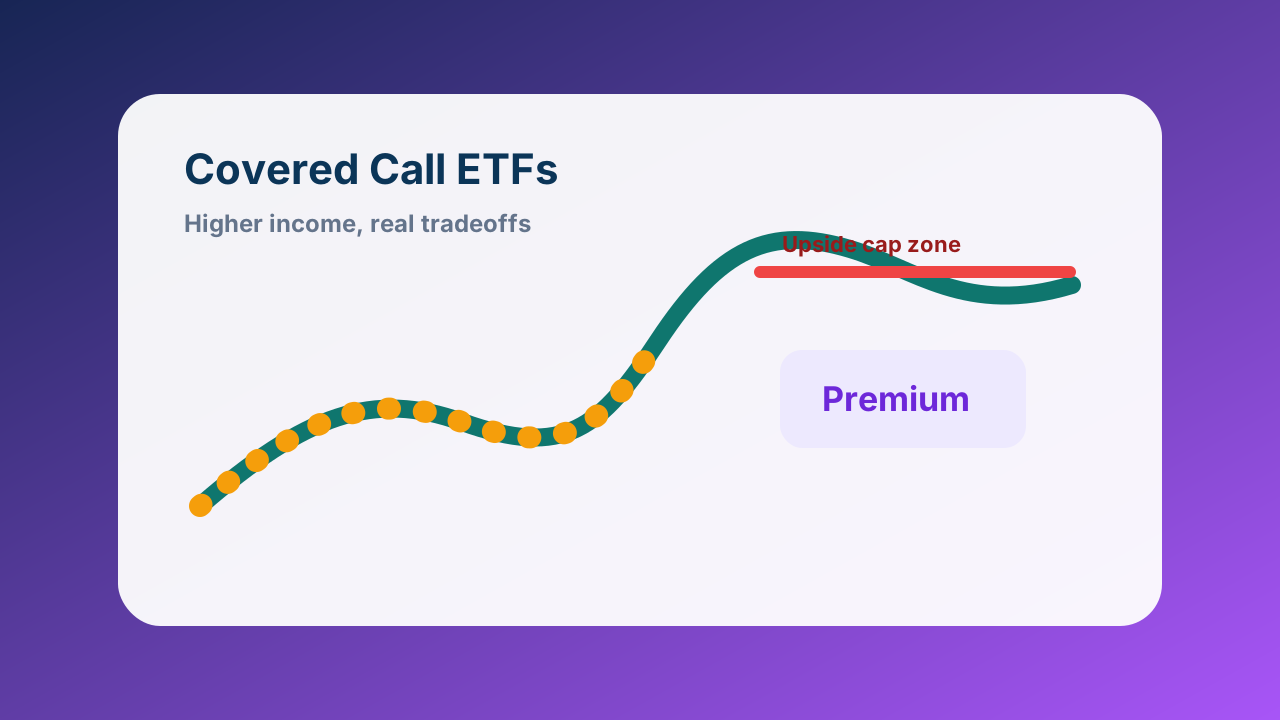
Covered call ETF in an RRSP illustration showing income distributions, retirement account fit, and capped-upside tradeoffs

Covered Call ETFs in an RRSP: Income, Tax Deferral, and Tradeoffs

Updated for 2026 Canadian rules
Quick AnswerDo covered call ETFs belong in an RRSP?

Covered call ETFs can fit an RRSP income or retirement-withdrawal plan, but they are not automatically ideal. RRSP tax deferral can simplify current-year reporting, while capped upside, distribution sustainability, retirement tax on withdrawals, and total-return tradeoffs still matter.

  • RRSPs defer tax; withdrawals are generally taxable later.
  • Covered call ETFs can support income but may cap part of the upside.
  • A high distribution is not the same as a strong retirement plan.
  • The RRSP account job should come before the ETF choice.

How to use this guide

Read for the decision, then verify the rule

What changes the answer?

Look for the income, timeline, account-room, province, tax, or risk assumption that would make the conclusion weaker.

What source applies?

Use the official links below for rules, limits, tax treatment, benefit dates, or mortgage guidance before acting.

What is not covered?

Personal tax history, contribution-room records, employer plans, debt terms, and household constraints may change the practical decision.

Founder review

Written and maintained by Easy Finance Tools

This page is written and maintained by Easy Finance Tools, checked against official Canadian sources where applicable, and not reviewed by a licensed financial advisor unless a reviewer is explicitly named.

Source verification

Checked against official Canadian sources where applicable

Last updated: July 6, 2026

Last verified for 2026: official rule pages and source links checked where they apply.

What was checked

  • - Primary source links where applicable
  • - Educational disclaimer and decision caveats
  • - Related calculator and guide links
  • - No professional review claim unless explicitly provided

Known limitations

  • - This guide cannot see personal account room, tax filing history, employment benefits, debts, or household constraints.
  • - Official rules and eligibility should be verified before acting.
This page is for education and planning support only. It is not financial, tax, legal, mortgage, or investment advice. Report an error or outdated source.

Covered call ETFs are often marketed around income. RRSP investors may see them as a retirement cash-flow tool because distributions can accumulate inside the registered account without annual taxable-account reporting.

That does not make the strategy automatically suitable. An RRSP is usually built for long-term retirement wealth and future taxable withdrawals. If a covered call ETF gives up too much growth or creates too much concentration, the tax-deferral wrapper may not compensate for the investment tradeoff.

The tradeoff: income today vs retirement growth

A covered call ETF typically holds securities and sells call options on some portion of the portfolio. Option premiums can support distributions, but the strategy may give up some upside when markets rise strongly.

In an RRSP, the account shelters current investment income and gains from annual tax reporting. The later withdrawal is generally taxable as income. That means the key RRSP question is not only payout size; it is whether the investment helps build sustainable after-tax retirement income.

RRSP use caseCovered call ETF may fit whenIt may be weaker when
AccumulationSmall satellite income sleeveIt replaces a diversified long-term growth core
Near retirementCash flow and lower volatility matterThe yield hides declining unit value
DrawdownDistributions support planned withdrawalsWithdrawals are driven by yield chasing instead of a plan
Tax simplicityYou want less taxable-account reportingYou forget RRSP withdrawals are taxable later

The tax context: deferral is not tax-free income

Inside an RRSP, current distributions generally do not create the same annual taxable-account reporting as a non-registered account. That can make income funds easier to hold administratively.

But RRSP withdrawals are generally taxable. A covered call ETF distribution inside the RRSP does not become permanently tax-free just because it was paid inside the account. The plan still has to consider future withdrawal tax rates, RRIF conversion, retirement income, and benefit interactions.

If you are choosing between TFSA and RRSP for an income ETF, the account decision should come first. TFSA flexibility and tax-free withdrawals can matter; RRSP deduction value and tax deferral can matter. Neither is always superior.

The investment context: yield, total return, and sequence risk

Retirement investors often care about sequence risk: the danger that weak returns early in retirement hurt long-term sustainability. Covered call ETFs can sometimes feel comforting because distributions arrive regularly, but the underlying holdings can still decline.

A high yield can also create false confidence. If unit price erosion or capped upside offsets the income, the portfolio may not be as healthy as the cash flow suggests. Compare total return, holdings, fees, and distribution history rather than payout rate alone.

For long RRSP timelines, the opportunity cost of capped upside can compound. For shorter timelines, the risk is assuming the ETF is cash-like when it still has equity risk.

  • Review the underlying holdings and sector concentration.
  • Compare distribution yield with total return and unit-price behaviour.
  • Check whether the ETF belongs in accumulation, transition, or drawdown.
  • Model lower-distribution and market-decline scenarios before relying on income.

The next path: match the ETF to the RRSP role

Before holding a covered call ETF in an RRSP, write down the RRSP's role. Is it a long-term growth account, a near-retirement transition account, or a retirement-income account? The same fund can look very different across those jobs.

Use the RRSP calculator to understand deduction and withdrawal tradeoffs, then use the dividend calculator to stress-test lower distributions. The result should be an educational plan, not a product shortcut.

What people misunderstand

What actually matters for Canadians

RRSP income is not tax-free

RRSP withdrawals are generally taxable, so current deferral should not be confused with permanent tax elimination.

Yield is not a retirement plan

A high payout must be tested against total return, volatility, fees, and sustainability.

Covered calls can lag rising markets

The option strategy can cap part of the upside in strong markets.

Tax location does not fix strategy risk

The account can change tax timing, but it cannot make a weak investment strong.

Before you decide

When this strategy may not fit

  • -You are still in a long accumulation phase and do not need income.
  • -You are replacing a diversified RRSP core only because the distribution is high.
  • -You have not modeled taxable RRSP withdrawals later.
  • -You would rely on the distribution for essential spending without a backup plan.

Common edge cases

Where the simple answer can be wrong

Foreign-listed covered call ETFs

Foreign withholding-tax and account-location details can differ. Verify product and tax treatment before acting.

RRIF conversion

Later minimum withdrawals may interact with income funds and cash-flow planning.

Return of capital signals

Tax character matters most in taxable accounts, but distribution composition can still reveal how payouts are funded.

Concentrated covered call funds

A sector-specific fund can combine strategy risk with sector risk.

Example scenario

Example: 20-year timeline vs 3-year retirement transition

A 35-year-old using an RRSP for 20 or more years of growth may not need an income-first ETF. A broad diversified portfolio could leave more room for compounding if markets rise over time.

A 62-year-old preparing for withdrawals may evaluate a covered call ETF differently. Cash flow may matter more, but the investor still needs to test unit-price declines, tax on withdrawals, and whether distributions can change.

Common mistakes

Mistakes to avoid

Chasing the highest distribution

The highest yield is not necessarily the strongest retirement outcome.

Ignoring withdrawal tax

RRSP withdrawals can change future after-tax income.

Skipping total return

Cash paid out is only one part of performance.

Using one ETF for every job

Accumulation, transition, and drawdown can require different risk choices.

Related content

Use these next

Each guide points to one practical calculator and two related guides so the next step stays educational instead of promotional.

How this article was prepared

Last updated: July 6, 2026

This guide applies Canadian RRSP account-location and retirement-income framing to covered call ETFs without recommending any fund.

Assumptions

  • The reader is considering covered call ETFs in an RRSP or RRIF planning context.
  • No specific ETF yield, distribution policy, or product ranking is assumed.
  • RRSP tax treatment is discussed educationally and should be verified for personal facts.

Sources and review

Self-reviewed by: Gourav Kumar

Checked against official Canadian source material where applicable; not reviewed by a licensed financial advisor, accountant, mortgage broker, or tax professional unless explicitly stated.

This page intentionally avoids product-specific yield claims.

Official sources

Official Canadian sources to verify

These primary references help readers verify the Canadian rules, limits, and tax treatment discussed in this guide.

Review note

Educational content, source-led review

This page is written for Canadian readers and reviewed against official or primary sources where the topic depends on rules, tax treatment, or account mechanics. The goal is to explain the decision, not to recommend a product or predict returns.

Last reviewed: July 6, 2026How we review content

Author and review

GK

Gourav Kumar

Founder of Easy Finance Tools

Independent Canadian personal finance tools creator focused on calculators, investing education, and beginner-friendly financial planning. Not a licensed financial advisor, accountant, mortgage broker, or tax professional.

How this content is handled

Content is educational, reviewed against official Canadian sources where applicable, and updated when account rules, calculator assumptions, or source material changes. It is not professional financial advice.

Educational disclaimer

This article is for educational planning only and is not financial, tax, legal, accounting, or investment advice.

Reader feedback

Was this useful?

This saves only in your browser for now; no account or tracking profile is created.

FAQ

Frequently asked questions

Are covered call ETFs allowed in an RRSP?

Many listed ETFs can be qualified investments, but you should verify the specific product and account treatment before acting.

Are covered call ETF distributions tax-free in an RRSP?

Current income can generally compound tax-deferred inside an RRSP, but RRSP withdrawals are generally taxable later.

Are covered call ETFs good for retirement income?

They may fit some income plans, but only after checking total return, distribution reliability, volatility, and withdrawal tax.

Does this article recommend covered call ETFs?

No. It explains RRSP account-fit tradeoffs for educational planning.

Back to Blog