Investing / U.S. Stocks / IPOs

Should Canadian Investors Chase Hot IPOs? The SpaceX Case Study

Published June 12, 202610 min read
By Gourav KumarReviewed against current Canadian source materialLast verified for 2026Fact-checked against official Canadian sourcesEditorial standardsReport an issue
GK

Gourav Kumar, Founder of Easy Finance Tools

Independent Canadian finance tools creator. Educational content only; not a licensed financial advisor, accountant, mortgage broker, or tax professional.

About the authorLast reviewed: Published June 12, 2026
Article visualInvesting / U.S. Stocks / IPOs
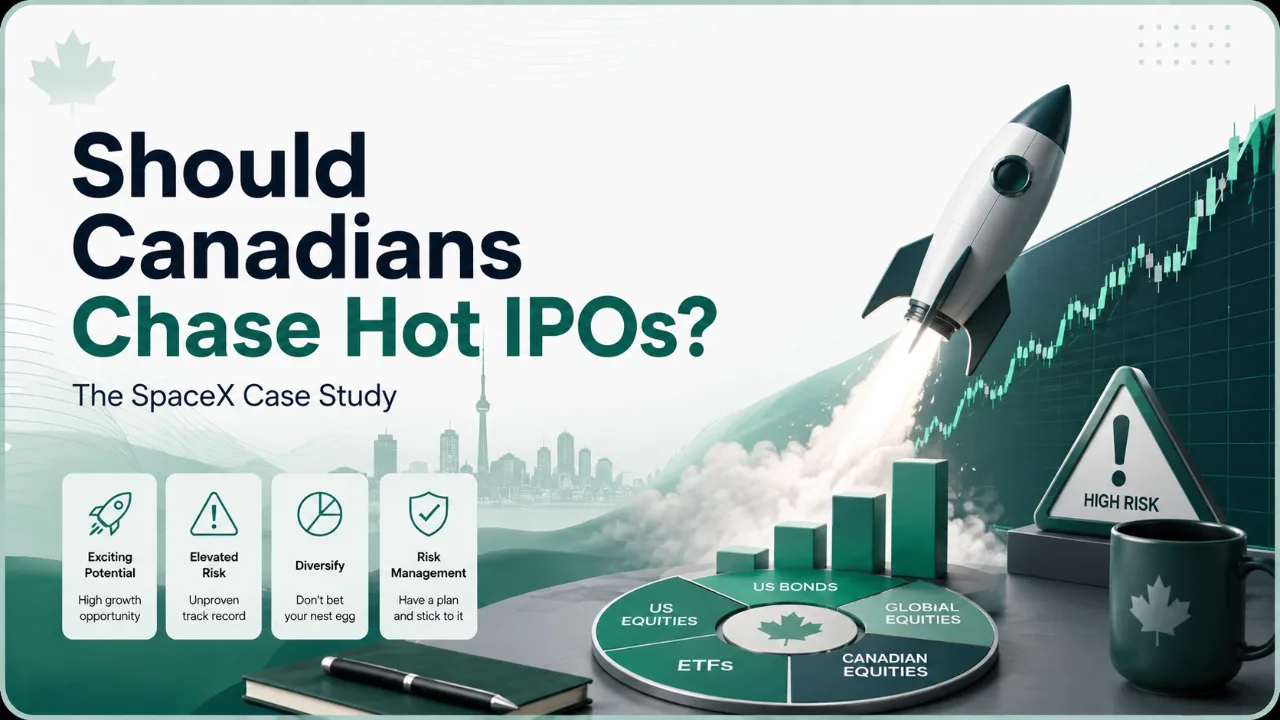
SpaceX IPO case study graphic for Canadian investors comparing hype, price, account choice, and risk controls

Should Canadian Investors Chase Hot IPOs? The SpaceX Case Study

Updated for 2026 Canadian rules
Quick AnswerShould Canadians chase a hot IPO like SpaceX?

A hot IPO can be worth researching, but it should not override account fit, position size, valuation, diversification, and order discipline. Canadian investors should separate the company story from the price they can actually pay.

  • A great company is not automatically a good investment at any price.
  • The IPO price and the first public trading price can be different.
  • Limit orders matter when a new listing is volatile.
  • TFSA, RRSP, FHSA, and non-registered accounts each create different tradeoffs.
  • Skipping a famous IPO can be reasonable if it does not fit the plan.

How to use this guide

Read for the decision, then verify the rule

What changes the answer?

Look for the income, timeline, account-room, province, tax, or risk assumption that would make the conclusion weaker.

What source applies?

Use the official links below for rules, limits, tax treatment, benefit dates, or mortgage guidance before acting.

What is not covered?

Personal tax history, contribution-room records, employer plans, debt terms, and household constraints may change the practical decision.

Founder review

Written and maintained by Easy Finance Tools

This page is written and maintained by Easy Finance Tools, checked against official Canadian sources where applicable, and not reviewed by a licensed financial advisor unless a reviewer is explicitly named.

Source verification

Checked against official Canadian sources where applicable

Last updated: June 12, 2026

Last verified for 2026: official rule pages and source links checked where they apply.

What was checked

  • - Primary source links where applicable
  • - Educational disclaimer and decision caveats
  • - Related calculator and guide links
  • - No professional review claim unless explicitly provided

Known limitations

  • - This guide cannot see personal account room, tax filing history, employment benefits, debts, or household constraints.
  • - Official rules and eligibility should be verified before acting.
This page is for education and planning support only. It is not financial, tax, legal, mortgage, or investment advice. Report an error or outdated source.

SpaceX's public-market debut gave investors exactly the kind of headline that creates fear of missing out.

The company priced its IPO at US$135 per share, opened around US$150, and traded sharply higher during its first day. For anyone watching from Canada, the emotional reaction is obvious: did I already miss it?

That is the wrong first question. A better question is whether buying a hot IPO fits your actual investment plan.

This article uses SpaceX as a case study for Canadian investors. It is not a prediction about where SpaceX stock will trade next. It is a framework for thinking clearly when a famous company, a powerful brand, and a fast-moving stock price all show up at once.

Day 1 update: what happened with SpaceX?

SpaceX priced its IPO at US$135 per share and raised about US$75 billion, making it one of the largest public offerings ever. Reuters reported that the pricing valued the company at roughly US$1.77 trillion.

On its first trading day, SpaceX opened around US$150, about 11% above the IPO price, and traded more than 20% above the IPO price intraday.

That matters because the IPO price is not always the price a public-market buyer can get once trading begins. If a company prices at US$135 but public buyers are seeing US$150, US$160, or more in the open market, the risk-reward picture has already changed.

The business may be the same, but the price is not. That is why a hot IPO should never be judged only by the company story. It has to be judged by the price you can actually pay.

Why hot IPOs create bad investor behaviour

Hot IPOs are built for attention. The company is famous, media coverage is constant, early investors talk about gains, social media turns the stock into a symbol, and brokerage apps make buying feel simple.

That environment pushes investors toward emotional decisions: buying because the company is famous, because the stock is moving fast, because other people are talking about it, or before deciding position size.

The most dangerous mistake is confusing a great company with a great stock price. A company can be excellent and still be risky at the wrong price.

  • Buying without knowing valuation.
  • Using money needed for short-term goals.
  • Treating first-day momentum as proof of long-term value.
  • Skipping the account and position-size decision.

The SpaceX lesson: IPO price is not your price

Many investors hear the IPO price and mentally anchor to it. For SpaceX, that number was US$135.

But once public trading begins, the relevant question changes. The practical question is what price you can actually buy at, and what return you would need from that price.

A stock that jumps 20% or more on day one may still go higher. It can also pull back quickly if early demand fades, valuation concerns grow, or short-term traders take profits. The first day does not prove the long-term outcome. It only proves that demand was strong at the opening.

Do you have to buy SpaceX stock?

No. SpaceX may be exciting, Starlink may be impressive, and the company may remain in the news. None of that means every Canadian investor needs to own the stock.

For many investors, the more useful question is not how to buy SpaceX. It is whether SpaceX fits inside the actual investment plan.

A diversified ETF portfolio can already give investors broad exposure to large public technology, communications, infrastructure, semiconductor, industrial, and cloud companies without putting too much money into one newly listed stock.

Why skipping a famous IPO can be reasonable

There are several reasons a Canadian investor might avoid or limit a hot IPO. Diversification usually matters more than excitement, time in the market usually matters more than catching one famous listing, and IPO prices can already include a lot of optimism.

By the time a famous private company reaches public markets, the story is usually well known. Early private investors, institutions, employees, and insiders may already have benefited from years of growth before public investors get access.

That does not make the stock bad. It means public investors should be careful about assuming they are still early.

The better question: where does it fit?

Instead of asking whether you should buy SpaceX, ask what role it would play in your portfolio.

For most investors, a newly listed single stock should not be the core of a portfolio. Core holdings are usually diversified funds, broad-market ETFs, or carefully planned long-term allocations.

A stock like SpaceX may fit, if at all, as a smaller satellite position around the edges of a diversified portfolio. The position can help if it performs well, but it should not damage the plan if it performs poorly.

If someone is buying only because the stock is moving fast, that is not really a long-term investment plan. It is a momentum trade.

A simple rule for Canadian investors

Before buying a hot IPO, decide four things first: what account you will use, what percentage of your portfolio the position will represent, what price you are willing to pay, and what would make you sell.

If you cannot answer those questions, you are probably not ready to buy. The stock may still be interesting, but the decision process is incomplete.

QuestionWhy it matters
What account will I use?The tax wrapper should fit the goal and timeline.
How large can the position be?Position size keeps a single stock from taking over the plan.
What price am I willing to pay?A limit protects against chasing a fast open.
What would make me sell?Exit rules reduce emotional decision-making later.

Limit orders matter

Hot IPOs can move quickly. A market order tells your brokerage to buy immediately at the available price. In a fast-moving stock, that price may be higher than expected.

A limit order lets you set the maximum price you are willing to pay. That does not guarantee you will get filled, but it helps prevent you from accidentally buying far above the price you had in mind.

For volatile IPOs, that discipline matters.

TFSA, RRSP, FHSA, or non-registered account?

Canadian investors also need to think about account type. A TFSA may be attractive for long-term growth because qualifying gains can be tax-free, but contribution room is limited and losses cannot be claimed.

An RRSP may make sense for long-term retirement investing, but withdrawals are taxable later. An FHSA is designed for a first home goal, so using it for a volatile IPO may not fit if the money is needed soon.

A non-registered account gives more flexibility, but gains, losses, and foreign currency tracking can create tax reporting work.

The right account depends on your goal, time horizon, tax situation, and risk tolerance. This is why the account decision should come before the stock decision.

What if SpaceX keeps rising?

It might. A strong company with strong demand can continue rising after an IPO.

But it might go up is not a complete investment thesis. You still need to ask what you are paying, what growth is already priced in, what happens if expectations cool, how much you can lose without damaging your plan, and whether you are buying because you understand the investment or because you feel behind.

If the only reason to buy is fear of missing out, that is not a plan.

What if SpaceX falls after the first pop?

That can happen too. Many IPOs experience early excitement, then volatility once the first wave of demand settles.

A pullback does not automatically mean the company is bad. It may simply mean the opening price ran ahead of what buyers were willing to keep paying.

For patient investors, waiting can sometimes provide a clearer entry point. Waiting is not weakness. Sometimes it is risk management.

SpaceX vs diversified ETFs

A diversified ETF will not feel as exciting as buying a famous IPO. That is the point.

A broad-market ETF spreads your money across many companies. You will not get the same emotional rush, but you also reduce single-company risk.

For many Canadian investors, the foundation should come first: emergency fund, high-interest debt repayment, account choice, diversified core portfolio, contribution plan, and risk management.

SpaceX may be optional. A clear investment plan is not.

Bottom line

SpaceX's IPO is a useful case study because it shows how quickly price, hype, and investor emotion can move together.

The company may be important, the stock may be popular, and the first-day move may be impressive. But Canadian investors do not need to chase every famous IPO.

Before buying, decide whether the stock fits your account type, time horizon, risk tolerance, and portfolio size. If it fits, keep the position small, use limit orders, and avoid money you need soon. If it does not fit, skipping it is a valid decision.

Educational disclaimer

This article is for educational planning only. It is not financial, investment, tax, legal, accounting, or technical advice. Investing involves risk, including the possible loss of capital. Always verify current market data and speak with a qualified professional before making decisions based on your personal situation.

What people misunderstand

What actually matters for Canadians

A famous company is not automatically a suitable holding

Suitability depends on price, account fit, time horizon, diversification, and the investor's ability to handle volatility.

The IPO price is not always the practical trading price

Once public trading begins, opening demand can put the available market price above or below the offering price.

Skipping is an active decision

Choosing not to chase a first-day move can be a disciplined decision when the position does not fit the plan.

ETFs and single stocks solve different jobs

A broad ETF is usually a portfolio foundation. A hot IPO, if used at all, is usually a smaller satellite or speculative position.

Before you decide

When this strategy may not fit

  • -You need the money within the next few years.
  • -You have not built emergency savings.
  • -You are buying only because the stock is moving fast.
  • -You have not decided account type, limit price, or position size.
  • -A sharp drop would force you to abandon your broader plan.

Common edge cases

Where the simple answer can be wrong

First-home money

An FHSA is designed around a home purchase. A volatile IPO may not fit if the down-payment timeline is short.

TFSA contribution room

TFSA growth can be powerful, but losses inside a TFSA do not create a deductible capital loss and contribution room is limited.

U.S. dollar exposure

A U.S.-listed stock adds CAD/USD conversion costs and currency movement to the stock-price decision.

Partial fills

A limit order may not fill, or may only partially fill, if the stock trades above the price you are willing to pay.

Example scenario

Example: the IPO price and the public price are different decisions

Suppose an IPO prices at US$135 but begins public trading around US$150. The company has not changed in that short window, but the buyer's price has. A Canadian investor should evaluate the actual order price, currency conversion, account fit, and position size instead of anchoring to the IPO price.

This is not a recommendation to buy or avoid SpaceX. It is a reminder that the price available to public-market buyers can change the decision.

Common mistakes

Mistakes to avoid

Using a market order in a volatile IPO

Fast openings can fill at a price higher than the investor expected.

Anchoring to the IPO price

The offering price can be psychologically powerful, but the investor's real decision is based on the price they can actually pay.

Making a single stock too large

Even a strong business can create portfolio risk if position size is too large.

Treating FOMO as research

Headlines and social proof are not substitutes for valuation, risk, and account-fit thinking.

Related content

Use these next

Each guide points to one practical calculator and two related guides so the next step stays educational instead of promotional.

How this article was prepared

Last updated: June 12, 2026

This article uses current Reuters market reporting, Canadian account-planning context, and EasyFinanceTools' education-first framework to turn a hot IPO headline into a portfolio decision checklist.

Assumptions

  • SpaceX first-day trading references use Reuters copy available through resolving Investing.com pages.
  • The article does not make a buy, sell, or hold recommendation.
  • Account fit depends on personal tax situation, contribution room, timeline, and risk tolerance.
  • Market prices can change quickly after publication.

Sources and review

Self-reviewed by: Gourav Kumar

Checked against official Canadian source material where applicable; not reviewed by a licensed financial advisor, accountant, mortgage broker, or tax professional unless explicitly stated.

Verify current market data, ticker details, account eligibility, and brokerage fees before placing any order.

Official sources

Official Canadian sources to verify

These primary references help readers verify the Canadian rules, limits, and tax treatment discussed in this guide.

Review note

Educational content, source-led review

This page is written for Canadian readers and reviewed against official or primary sources where the topic depends on rules, tax treatment, or account mechanics. The goal is to explain the decision, not to recommend a product or predict returns.

Last reviewed: June 12, 2026How we review content

Author and review

GK

Gourav Kumar

Founder of Easy Finance Tools

Independent Canadian personal finance tools creator focused on calculators, investing education, and beginner-friendly financial planning. Not a licensed financial advisor, accountant, mortgage broker, or tax professional.

How this content is handled

Content is educational, reviewed against official Canadian sources where applicable, and updated when account rules, calculator assumptions, or source material changes. It is not professional financial advice.

Editorial standardsCalculator methodologyUpdated: June 12, 2026Investing / U.S. Stocks / IPOs

Educational disclaimer

This article is for educational planning only. It is not financial, investment, tax, legal, accounting, or technical advice. Investing involves risk, including the possible loss of capital. Always verify current market data and speak with a qualified professional before making decisions based on your personal situation.

Reader feedback

Was this useful?

This saves only in your browser for now; no account or tracking profile is created.

FAQ

Frequently asked questions

Should Canadian investors chase hot IPOs?

Not by default. A hot IPO should be evaluated against the investor's plan, account choice, position size, valuation, diversification, and risk tolerance.

What happened on SpaceX's first trading day?

Reuters reported that SpaceX priced at US$135, opened around US$150, and traded more than 20% above the IPO price intraday.

Is the IPO price the same as the price public buyers can get?

Not always. Once trading begins, the market price can open above or below the IPO price and move quickly.

Should SpaceX go in a TFSA, RRSP, FHSA, or taxable account?

There is no universal answer. TFSA, RRSP, FHSA, and non-registered accounts have different tax, timeline, flexibility, and risk tradeoffs.

Are diversified ETFs a replacement for a SpaceX position?

They are not the same investment, but diversified ETFs can provide broad market exposure without relying on one newly listed company.

Back to Blog